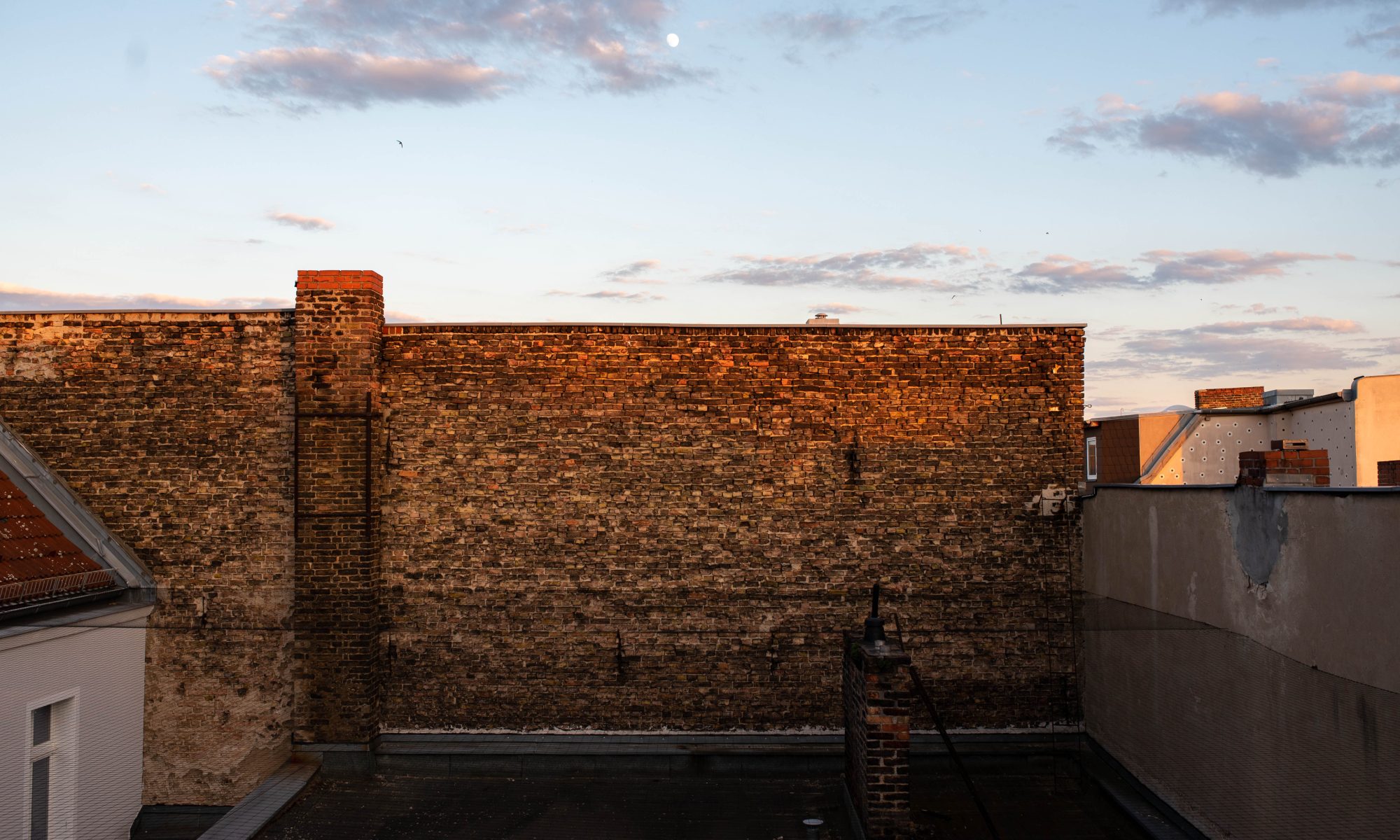
There are places in Berlin that cannot be papered over. Cracks made by War and Wall remain, strangely disguised. After awhile you become adept at spotting them, and they grow familiar to you. I treasure them. These are places where the seeds of hotels and malls will not take root. Some are made on purpose, some have simply emerged in time, like scar tissue on the city.
The old death strip of the Berlin Wall, that place between the inner and outer walls where guards patrolled, towers stood, dogs sniffed, lights burnt, fences tripped and bullets ripped, has largely disappeared save for major monuments like the one along the Bernauer Strasse. Yet does the city itself remember the barricade that once “cut into the living flesh” of the city, to quote a witness to its construction?
Can a city remember at all, or does it rely on its human inhabitants to order the marks of the past either through destruction or memorialisation? I can’t give a definite answer to that question, but surprising things emerge. Cycling along the path of the Berlin Wall in Pankow, far away from the center of the city, I find myself amidst white birch woods in a narrow corridor. Packed together,
slim like unsmoked cigarettes, they constitute a regal gathering. I cannot ignore them. Behind me a group of tourists have paid good money to struggle along this very beaten track, where sometimes we have to get off and push out of fear for our tires. I stop them and explain that the birch trees are here because they are pioneer trees. Wherever a sudden gap occurs, on good soil, they will rise up. They now grow in most of the parts of the old Death Strip that hasn’t been developed. These white trees, so fey and lithe, are the opposite of memory. They don’t, as far as we can tell, know that they mark the path of the Berlin Wall, and nobody put them there. Yet they eradicate the look of the death strip as it was, and indict its ugliness with their beauty.
In opposition to this are places that humans have said cannot be developed or inhabited. Tainted ground where pioneer trees can’t grow, because they are to be left open at all costs. An empty wounded place like the Topography of Terror in Mitte, where a vast stone-covered area marks out the former site of the Gestapo headquarters. Alongside this open place are the remains of the Berlin Wall that ran between Mitte in the east and Kreuzberg in the west for 28 years. A museum has been built there, next to an area excavated in the late 1980s to reveal prison cells that once stood in the basement of 8 Prinz Albrecht Strasse. “8 Prinz Albrech Strasse”: the centre of the Nazi terror apparatus, where names shorn of power still haze the air around tour guides and visitors with painful wounds, names like ‘SS’ ‘Gestapo’ ‘Einzatsgruppen’ ‘Death Heads’. Open and exposed to the air all year round, this place stands as if in hope that with enough time and exposure their stains will wash clean.
Wishful thinking of course. All you need to do is look up, to the left, and see the field of stones. Brutal stones, the opposite of growing things, on a place not allowed to seed life again. If a tree peeped through, it would be cut down.
I realised recently, standing there with a tour group in early spring, that the Holocaust Memorial is the same kind of place. It occupies a large central block of Berlin. Nothing will grow there ever again. Its harsh geometric shape, its blocks of stone, will never shelter the slender bodies of pioneer trees. No one could dream up better memorials than these, locking away the promise of growth, keeping back the tide of change, making empty places in a capital city always and endlessly being built, and rebuilt again.
Both stories are the same. The pioneer trees like scar tissue, rising quietly in places left behind by the Berlin Wall. The places forbidden to grow ever again. We are hardly listening anymore. It is, after all, the city that remembers now.
© Lauren van Vuuren
Berlin 2024
 Lauren van Vuuren